
Walk into any pro shop and ask about swing weight – most golfers draw a blank. Yet swing weight is one of the three most critical variables in club fitting after loft and lie and it directly affects tempo, feel, and consistency on every shot.
At Mitchell Golf, we have been manufacturing swing weight scales and fitting equipment used in PGA Tour vans and pro shops worldwide since 1988. This guide gives you the definitive, technically accurate explanation of swing weight, without the marketing fluff.
1. What Is Swing Weight?
Swing weight is a measure of how head-heavy a golf club feels when you swing it. It is not total club weight a club can weigh the same total mass but feel dramatically different depending on how that weight is distributed along the shaft.
Think of it like a see-saw. If you balance a club on a fulcrum placed 14 inches from the grip end, the position where it balances reflects the weight distribution ratio between the head end and the grip end. Swing weight quantifies this balance.
Technical Definition: Swing weight is formally defined as the torque required to move a club about a fulcrum point located 14 inches from the butt end of the grip. It is measured on a swing weight scale and expressed as a letter-number code (e.g., D2). A higher swing weight means more weight is effectively felt at the clubhead end of the lever.
Critically, swing weight is about feel, not physics. Two clubs with identical swing weights will feel the same in terms of head heaviness, even if one is graphite-shafted at 290 grams total and the other is steel-shafted at 420 grams total. This is counterintuitive and it is why swing weight is often misunderstood.
Critically, swing weight is about feel, not physics. Two clubs with identical swing weights will feel the same in terms of head heaviness, even if one is graphite-shafted at 290 grams total and the other is steel-shafted at 420 grams total. This is counterintuitive and it is why swing weight is often misunderstood.
2. The A–E Swing Weight Scale
The swing weight scale runs from A0 (lightest) through E9 (heaviest), using a letter-number system. Within each letter grade, numbers 0–9 provide finer resolution. Each single swing weight point represents approximately 0.07 ounces (about 2 grams) of effective head-end weight difference.
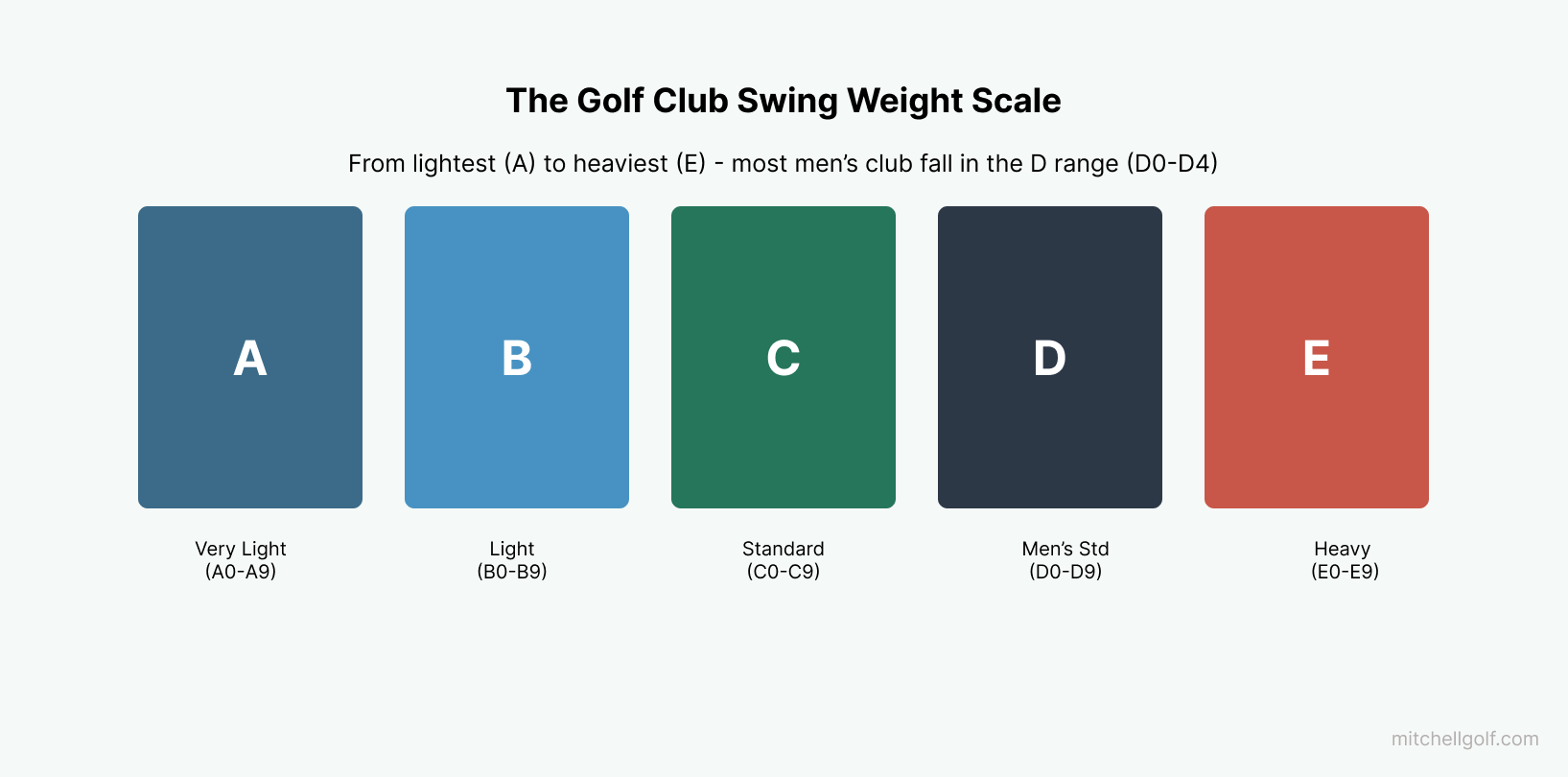
Figure 1: The swing weight scale from A (lightest) to E (heaviest). Most men’s clubs fall in the D range. Mitchell Golf Equipment Co.
| Swing Weight Range | Feel Category | Typical User |
|---|---|---|
| B0–B9 | Light — easy to swing fast | Ladies, seniors |
| C0–C9 | Moderate — balanced feel | Ladies, juniors, some men |
| D0–D4 | Standard men’s — clear head feel | Most men’s off-the-shelf clubs |
| D5–D9 | Heavy — pronounced head weight | Stronger players, custom builds |
3. D0, D1, D2, D3: What Each One Actually Feels Like
The D range is where the vast majority of men’s golf clubs live. Understanding the nuance between D0 and D3 is essential for fitting and custom building.
D0 – Light-Standard
Head barely noticeable during the swing. Promotes a fast swing tempo and quick clubhead release. Best for players with quick transitions or those who struggle with timing the lighter feel keeps the head from lagging too far behind. Often used in lightweight graphite-shaft builds and senior-flex designs. Players who naturally time the release well may find D0 gives them maximum clubhead speed without sacrificing feel.
D1 – Standard
Slight head awareness during the swing. Versatile and forgiving suitable for a wide range of swing speeds, tempos, and playing styles. A common specification for stock men’s drivers and fairway woods from major manufacturers. If you are unsure of your ideal swing weight, D1 is an excellent starting point for testing.
D2 – Standard-Firm
Clear, noticeable head feel throughout the swing arc. Provides excellent feedback and stability at impact. The most common specification for men’s irons straight off the shelf. Favored by players with controlled, repeatable swings who want to feel the clubhead without fighting it. Most mid-handicap golfers testing clubs for the first time will find D2 feels “right.”
D3 – Firm
Definite head weight awareness you feel the weight throughout the backswing, transition, and downswing. Promotes a smooth, deliberate tempo by encouraging the player to let the head lag slightly and then release through impact. Preferred by many tour professionals for irons and wedges where precise distance control and feel are paramount. Higher-swing-speed players who tend to rush the transition benefit from D3’s natural tempo-slowing effect.
The Penny Test: Going from D0 to D1 to D2 to D3 each represents about 0.07 ounces roughly the weight of a single penny. From D0 to D3 is approximately the weight of three pennies added to the effective head end of the lever. Small numbers with a significant, perceivable feel difference.
4. Standard Swing Weight by Club Type (2026)
Not all clubs in a bag are built to the same swing weight specification nor should they be. Here are the industry-standard ranges by club category for 2026.

Figure 2: Standard swing weight ranges by club type. Men’s clubs are typically D0–D4; women’s C4–C9. Mitchell Golf Equipment Co.
| Club Type | Men’s Swing Weight | Women’s Swing Weight | Seniors |
|---|---|---|---|
| Driver | D0–D3 | A0–C0 | B8–C5 |
| 3-Wood | D0–D3 | B5–C5 | C0–C6 |
| 5-Wood | D1–D3 | C0–C6 | C2–C7 |
| Hybrids | D1–D3 | C0–C7 | C3–C8 |
| Long Irons (2–4) | D1–D3 | C3–C8 | C4–C9 |
| Mid Irons (5–7) | D2–D4 | C4–C9 | C5–D0 |
| Short Irons (8–9) | D2–D4 | C5–C9 | C6–D1 |
| Wedges (PW–LW) | D2–D5 | C5–D0 | C6–D2 |
| Putter | D2–D6 | C5–D2 | C7–D3 |
5. How Swing Weight Affects Feel, Control, and Distance

Figure 3: Swing weight vs. performance characteristics. D1–D3 represents the optimal balance zone for most players. Mitchell Golf Equipment Co.
The Feel Dimension
Swing weight directly affects what you perceive during the swing and at impact. A heavier swing weight (D3–D5) creates more awareness of the clubhead throughout the swing arc you know where the head is at every point in the motion. This “feeling the head” helps players with smooth tempos maintain timing and sequence. A lighter swing weight (C7–D0) reduces that awareness, making the club feel more like an extension of the arms better for players who naturally time the release without needing proprioceptive feedback from the head end.
The Tempo Connection
Research on tour player swing analysis consistently shows that players with slower, smoother tempos (the classic “effortless power” swing) tend to prefer slightly higher swing weights (D3–D5), while players with quick, aggressive transitions benefit from lighter weights (D0–D2). The reason is biomechanical: a heavier head naturally encourages the hands to slow down and let the clubhead catch up, which produces a smoother, more sequenced tempo. Fighting against that weight with an aggressive transition tends to produce early releases and inconsistent ball striking.
The Distance Factor
A common misconception is that lighter swing weight automatically means more distance. This is only true when swing weight is so heavy that it measurably slows clubhead speed. Within the normal D range (D0–D5), swing weight has minimal direct effect on distance. The indirect effect via tempo and timing is far more significant. A swing weight that improves your timing will improve your distance. One that disrupts timing will cost you yards regardless of total club weight.
The Fitting Rule of Thumb: If a player feels their clubs are “too whippy” or “hard to control,” increase swing weight by 2–3 points. If they feel “sluggish” or “hard to get through the ball,” decrease by 2–3 points. Make small changes and re-test the optimal range is often within a 2-point band for any individual player.
6. What Changes Swing Weight
Four variables primarily determine a club’s swing weight: head weight, shaft weight distribution, shaft length, and grip weight. Understanding how each one moves the swing weight needle is essential for any club fitting or building operation.

Figure 4: How key club variables affect swing weight. Adding head weight increases SW; heavier grip decreases SW; longer shaft increases SW. Mitchell Golf Equipment Co.
| Variable | Change | Swing Weight Effect | Notes |
|---|---|---|---|
| Head weight | +2 grams | +1 SW point | Most efficient way to increase SW |
| Head weight | -2 grams | -1 SW point | Requires material removal (grinding) |
| Shaft length | +0.5 inch | +3 SW points | Significant leverage effect |
| Shaft length | -0.5 inch | -3 SW points | Common in fitting for shorter golfers |
| Grip weight | +10 grams | -1.5 SW points | Counter-weighting effect |
| Grip weight | -10 grams | +1.5 SW points | Lighter grip = more head feel |
| Shaft tip weight | +5 grams | +2 SW points | Tip inserts used in reshafting |
| Lead tape on head | 1 inch strip (~3g) | ~+0.5 SW points | Quick field adjustment, reversible |
The Shaft Length Effect – The Most Powerful Variable
Most fitters focus on head weight when adjusting swing weight, but shaft length has a far more powerful lever effect. Cutting half an inch off a shaft drops swing weight by approximately 3 points instantly turning a D2 into a C9. This is precisely why clubs fitted for shorter golfers need head weight added back after any shaft shortening. Failing to account for this is one of the most common club fitting errors seen in pro shops.
For reshafting work, always measure swing weight after every job. When replacing a shaft, the new shaft may have a different butt/tip weight distribution that shifts swing weight even if the total shaft weight is identical. See Mitchell Golf’s complete Re-Shafting tools and supplies for professional equipment.
7. How to Measure Swing Weight Professionally
Accurate swing weight measurement requires a calibrated swing weight scale a precision balance instrument designed specifically for this purpose. The basic 14-inch fulcrum design has been the industry standard since the 1940s; modern professional scales add digital readouts and improved repeatability.
- Place the club on the scale with the grip end at the 14-inch reference point from the butt end.
- Allow the balance arm to find its resting position. On a mechanical scale, read the letter-number code from the indicator pointer. On a digital scale, read the display directly.
- Record the reading for each club. For an iron set, all clubs should ideally fall within 1 swing weight point of each other. Discrepancies larger than 2 points indicate components that need attention.
- For new builds: measure swing weight before and after installing the grip to account for grip weight in the final specification.
- Document all readings on a fitting card alongside loft, lie, and shaft data for a complete club specification record.
Professional Standard: Mitchell Golf swing weight scales are used by PGA Tour professionals and major club manufacturers worldwide. They provide the accuracy and repeatability required for professional club work. Available through mitchellgolf.com/product-category/fitting/
8. How to Adjust Swing Weight on Your Clubs
Swing weight adjustment is a routine part of professional club building and fitting. Here are the four primary methods, from simplest to most involved:
Method 1: Lead Tape (Quick Field Adjustment)
Apply lead tape to the sole or back of the clubhead. One standard 1-inch strip adds approximately 0.5 swing weight points. This is the fastest way to experiment with swing weight feel before committing to a permanent change. Players often use lead tape on-course during a fitting session to find their preferred feel range before making component changes.
Method 2: Shaft Tip Insert Weights
Small cylindrical weights inserted into the tip end of the shaft before assembly (or accessed through the hosel on assembled clubs). These tip weights add mass close to the head end of the lever, efficiently increasing swing weight. Widely used in professional reshafting operations to dial in the exact swing weight spec after a shaft change.
Method 3: Grip Weight Adjustment
Switching to a heavier or lighter grip changes swing weight through counter-weighting. Moving from a 50g standard grip to a 70g grip drops swing weight by approximately 3 points. Conversely, a lighter 40g grip increases swing weight by about 1.5 points. This is a clean, reversible method with the added benefit of also renewing the grip surface. Always re-measure with a scale after any grip change.
Method 4: Shaft Length Adjustment
Extending or shortening the shaft is the most powerful swing weight adjustment but it carries the most implications, simultaneously changing lie angle, flex point, overall feel, and shaft frequency. Always re-measure swing weight after any shaft length change and compensate with head weight addition or removal to return to target specification.
Warning Always Measure, Never Guess: Always verify swing weight with a scale after any adjustment. Even experienced club builders are regularly surprised by how combinations of changes interact. A new shaft, repositioned grip, and added tip weight can combine in unexpected ways. Measure before and after every single modification.
9. Set Swing Weight Matching – Why It Matters
One of the most important and most commonly neglected aspects of iron set fitting is swing weight consistency across all clubs. A properly matched set has all irons within 1 swing weight point of the target specification. When swing weight varies widely across a set, clubs feel different from each other even if they look identical. This forces the player to make unconscious compensations from club to club, destroying the consistency that proper fitting is meant to deliver.
Why Sets Get Out of Spec
- Mixing irons from different years or different model lines with different component specifications
- Shaft replacements using shafts with different weight distribution profiles, even if total weight is similar
- Grip replacements with different-weight grips without measuring swing weight before and after
- Shaft length adjustments (for custom fitting) without head weight compensation
- Progressive shaft weights (tip-heavy vs. butt-heavy) creating unintended swing weight variations across the set
The 1-Point Rule: Professional club builders target all irons within 1 swing weight point of the spec (for example, all at D2 ± 1). Sets that vary by 3 or more points across the iron range will feel inconsistent no matter how well they’ve been fitted for loft, lie angle, and shaft flex. Always include swing weight in any set evaluation it is not optional.
10. What Swing Weight Do PGA Tour Players Use?
PGA Tour equipment data gathered through fitting van records and manufacturer specifications over more than three decades consistently shows the following patterns among tour professionals:
| Club Category | Typical Tour Range | Notes |
|---|---|---|
| Driver | D1–D3 | Varies by player; graphite shafts trend lighter |
| Fairway Woods | D1–D3 | Often matched to driver feel preference |
| Long Irons / Hybrids | D2–D4 | Many players increase SW in long irons for better tempo |
| Mid Irons (5–7) | D3–D5 | Precise shots demand higher SW for feel and control |
| Short Irons (8–9) | D3–D5 | High SW for consistent impact feel |
| Wedges | D4–D6 | Highest SW in bag; maximum feel for short game |
| Putter | D4–D8+ | Wide variation; many tour putters are very heavy SW |
The Tour Wedge Anomaly
A notable pattern: many tour players intentionally play their wedges at a significantly higher swing weight (D4–D6) than their irons (D2–D4). This is a deliberate technique to slow the tempo around the greens and improve feel on partial shots particularly the 40–80 yard “scoring shots” where feel and distance control are most critical. This is counter-intuitive to many amateurs who assume a fully consistent swing weight across the entire bag is always optimal.
For technical reference on professional club measurement standards, refer to the Mitchell Golf Measuring & Bending Guide (PDF) the standard reference used in PGA Tour van operations.
11. Mitchell Golf Fitting Products
Mitchell Golf manufactures the fitting and measurement equipment used by professionals worldwide. For swing weight measurement and adjustment, the following products are essential:
Swing Weight Scales
Professional-grade swing weight scales for accurate, repeatable measurement. Used in PGA Tour vans and pro shops for over 30 years. View all Fitting Equipment
Re-Shafting Equipment
Shaft pullers, epoxy systems, ferrule kits, tip inserts, and shaft weights for professional reshafting with precise swing weight control. Shop Re-Shafting Tools
Loft & Lie Machines
TourGauge Digital and SteelClub Signature angle machines verify loft and lie alongside swing weight for complete club specification. Shop Loft & Lie Machines
Grip Stations & Re-Gripping Equipment
Professional grip stations, vises, grip tape dispensers, and solvent systems for complete re-gripping operations. Grip changes directly affect swing weight always re-measure after regripping. Shop Grip Stations
Professional Training Classes
2-Day Introductory Class and 5-Day Master Performance School hands-on training in swing weight matching, loft/lie adjustment, reshafting, and complete club building. Learn the skills used by PGA Tour technicians. View Class Schedule
12. Frequently Asked Questions
Q: What does D2 swing weight mean?
D2 is a standard swing weight for men’s irons and drivers. It indicates the club feels moderately head-heavy during the swing heavy enough to provide a solid feel and control, light enough to maintain clubhead speed. Most off-the-shelf men’s irons are built to D2 or D3. It is the most common single swing weight specification in the industry.
Q: What is the difference between D0, D1, D2, and D3 swing weight?
Each point represents approximately 0.07 ounces (about 2 grams) of effective weight difference at the clubhead end of the lever. D0 feels lighter and faster; D3 feels heavier and more stable. Going from D0 to D3 represents about 0.21 ounces of difference roughly the weight of a penny and a half. The perceived difference between adjacent points (e.g., D1 to D2) is subtle but real; most experienced golfers can detect a 2-point swing weight change during a fitting session.
Q: Is a heavier swing weight better?
Not universally. A heavier swing weight (D3–D5) can improve feel and tempo consistency for players with controlled, smooth swings – but can cause fatigue and timing disruption for players with faster, more aggressive transitions. The optimal swing weight depends on your swing speed, tempo, physical strength, and what feels most natural. Fitting is the only reliable way to determine your optimal range.
Q: How do I measure swing weight?
Swing weight is measured using a swing weight scale – a 14-inch fulcrum balance device. The club is placed on the scale and the swing weight is read from where it balances on the letter-number scale (A through E, 0 through 9). Professional swing weight scales from Mitchell Golf provide accurate, repeatable readings for fitting and club building operations. Available at: mitchellgolf.com/product-category/fitting/
Q: How does grip weight affect swing weight?
Grip weight significantly affects swing weight because grips sit at the opposite end of the fulcrum from the clubhead. Adding 10 grams to the grip reduces swing weight by approximately 1.5 points. Switching from a 50g to a 70g grip can drop swing weight by 3 full points turning a D2 into a C9. This is why even a routine grip change requires re-measuring swing weight and potentially adding compensating head weight.
Q: What swing weight should women’s clubs be?
Women’s clubs are typically built to C4–C9 swing weight. Ladies drivers are often in the A0-C0 range. Women who have developed a stronger, faster swing may find C9 or D0 more appropriate and may benefit from custom fitting to determine the optimal range. Never assume gender-based specifications are correct for an individual always fit to the player.
Q: Can I change the swing weight of my clubs?
Yes. Swing weight can be adjusted by adding weight to the clubhead (lead tape, screw weights, hosel inserts), using shaft tip insert weights, adjusting grip weight, or changing shaft length. All adjustments should be verified on a calibrated swing weight scale. Reducing swing weight requires removing material or replacing components with lighter alternatives.
Q: What swing weight do PGA Tour players use?
Most PGA Tour players use irons between D2 and D5, with drivers typically D1–D3. Many tour professionals intentionally play wedges at D4–D6 heavier than their irons to slow tempo and improve feel on short game shots. Some players even vary swing weight progressively across the iron set (lighter long irons, heavier short irons) to equalize feel across different shaft lengths.