
What Makes Steel and Graphite Shafts Different?
At the most fundamental level, the shaft is the engine of a golf club. It stores and releases energy, controls the timing of the clubhead at impact, and communicates feel back to the golfer’s hands. The material determines every one of those functions.
Steel Shaft Construction
Modern steel golf shafts are made from carbon steel alloy, drawn into a tapered tube and heat-treated for strength. The manufacturing process is highly consistent two steel shafts from the same batch will have nearly identical stiffness profiles, weights, and torque values. This predictability is a major reason why professional and competitive golfers favor steel.
Steel iron shafts typically weigh between 95 and 130 grams and have torque values of 1.5° to 2.5° — very low, meaning the shaft resists twisting under load. This produces a stiffer, more direct response at impact.
Graphite Shaft Construction
Graphite shafts are made from layers of carbon fiber woven around a mandrel, then cured with heat. The fiber orientation, number of layers, and resin type can all be varied to tune performance which gives designers enormous flexibility to create shafts with specific stiffness patterns, flex points, and torque profiles. Graphite shafts for irons typically weigh 65–90 grams, with torque values ranging from 2.0° to 5.0°.
Mitchell Golf Technical Note: The torque value (measured in degrees) is often overlooked when comparing shafts. A graphite shaft with 4.5° torque will feel dramatically different from one with 2.5° torque, even if both are labeled “Regular flex.” Always ask for actual torque specs.
Weight: The Most Important Variable
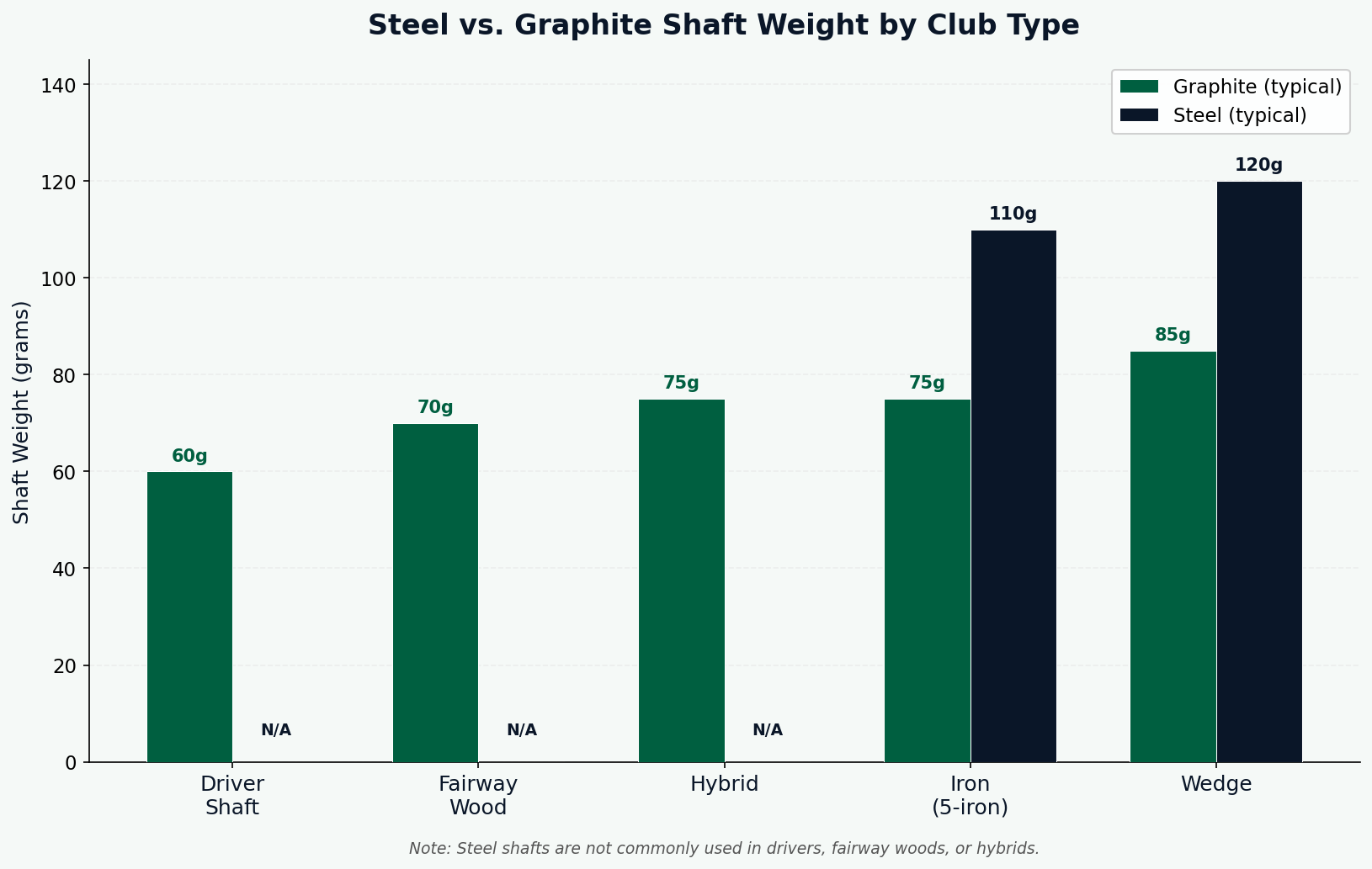
Graphite iron shafts run about 30–35% lighter than their steel counterparts. For a full iron set (7 clubs), that’s roughly 245 grams less total shaft weight across the bag — a significant difference in how the clubs feel and perform.
How Weight Affects Your Swing
Heavier shafts (steel) require more muscular engagement to swing at the same speed. For high-swing-speed players, this is an advantage: the additional mass helps with timing and prevents over-swinging. For players with slower speeds, less strength, or physical limitations, that same mass works against them.
Lighter graphite shafts allow players to swing faster with less effort. The caveat: if the lighter shaft disrupts a player’s tempo, contact quality drops and any speed gain is negated.
Pro Shop Tip: When converting a set from steel to graphite, always recheck swing weight. Removing 35–40g of shaft weight typically reduces swing weight by 4–6 points (e.g., D2 to C6). Add head weight or counterweighting to restore balance.
Swing Speed Guide: Who Should Play What
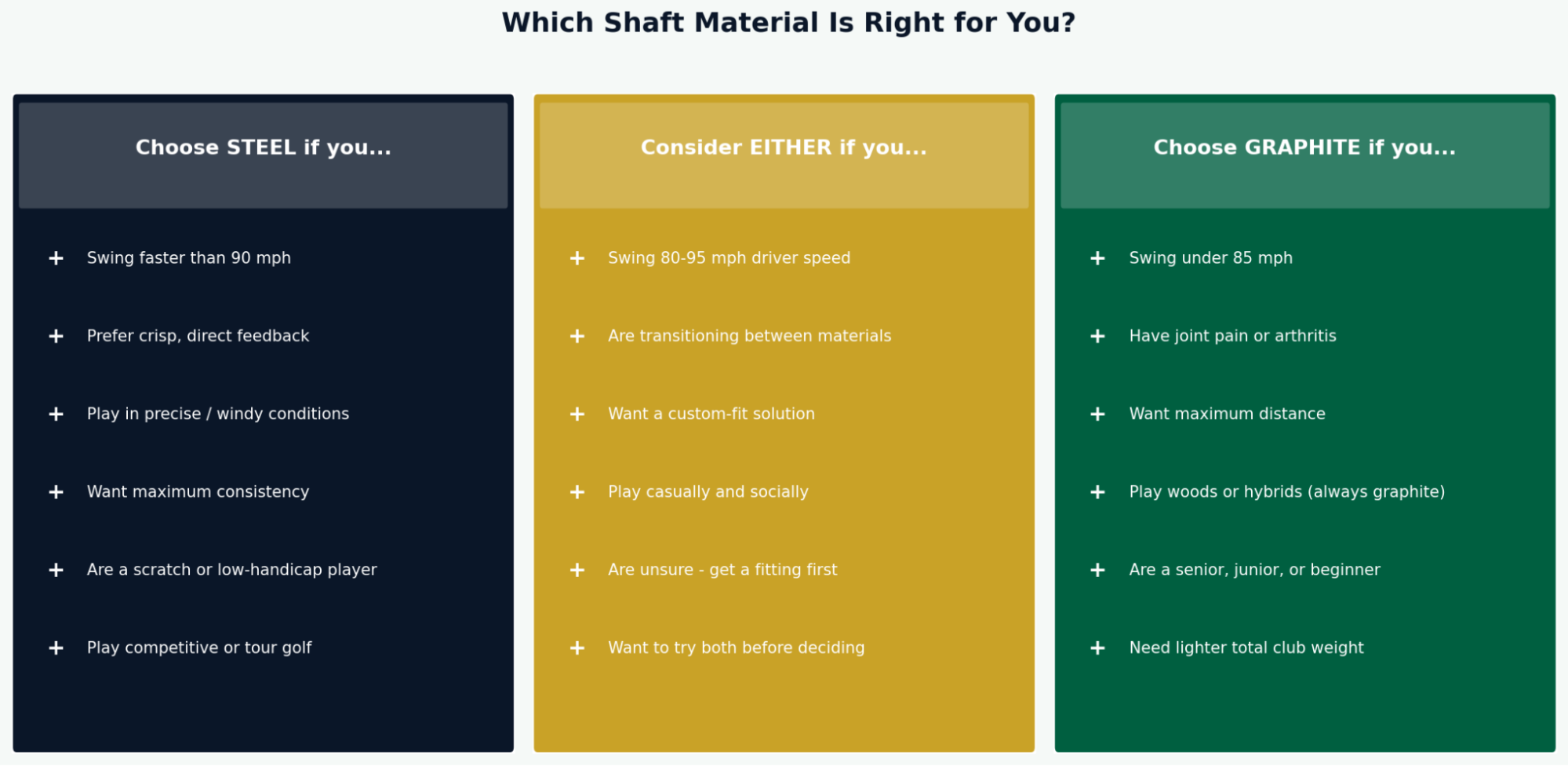
Swing speed is the single most reliable predictor of which shaft material will serve a golfer best.
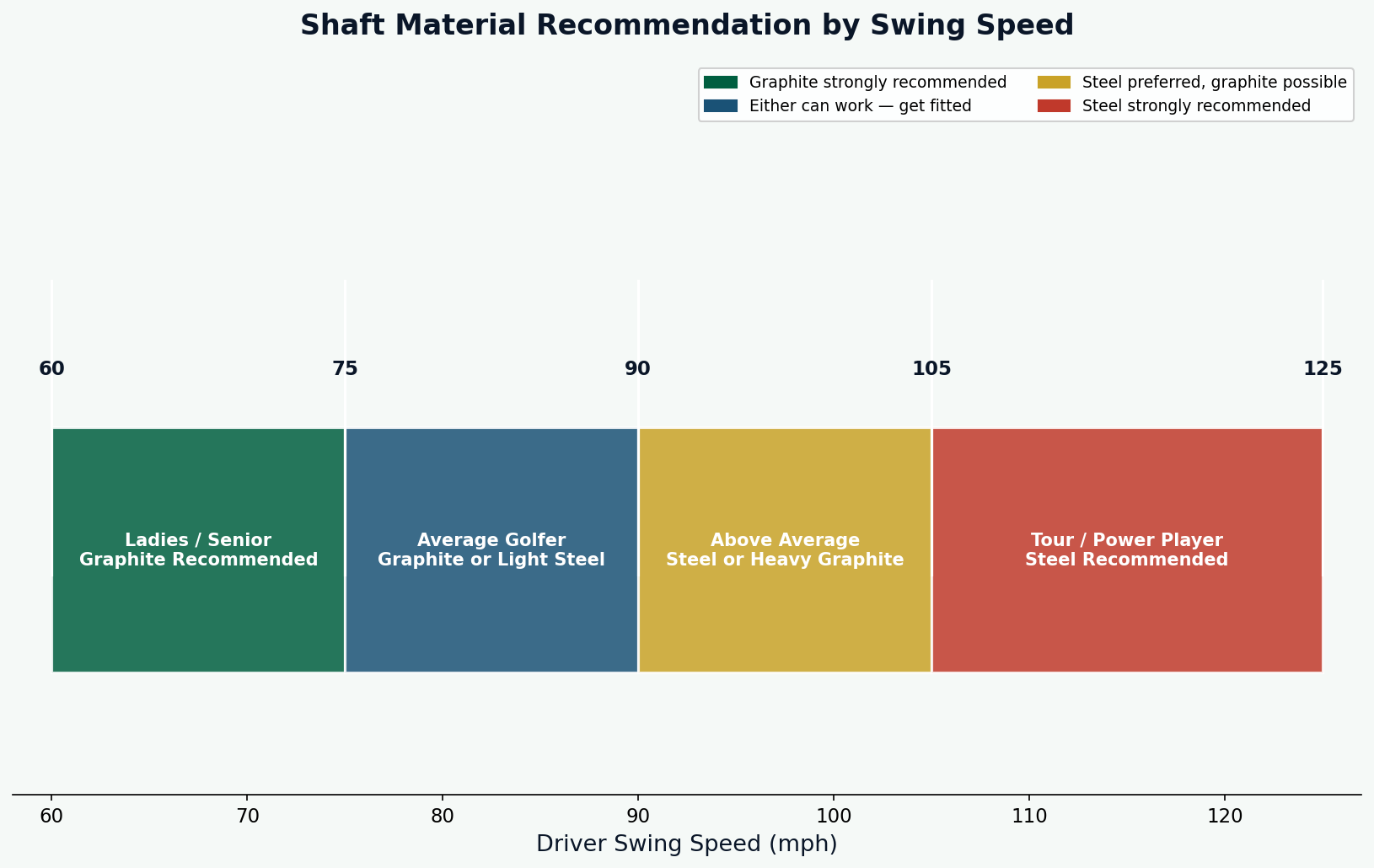
| Driver Swing Speed | Player Profile | Recommended Material | Primary Reason |
| Under 70 mph | Juniors, some seniors | Graphite (Ladies/Senior flex) | Maximum speed from minimum weight |
| 70–85 mph | Average recreational golfer | Graphite strongly recommended | Weight, distance, joint comfort |
| 85–95 mph | Mid-handicap golfers | Either — get a fitting | True grey zone; feel preference matters |
| 95–105 mph | Low-handicap, competitive golfers | Steel preferred | Timing, consistency, feedback |
| 105+ mph | Scratch golfers, tour players | Steel or tour graphite | Maximum control and load transfer |
One common misconception: handicap is not swing speed. A 20-handicapper with a smooth 95 mph tempo may play better with steel than a 5-handicapper swinging at 78 mph. Always evaluate material choice based on swing speed data, not score.
Feel, Feedback, and Vibration
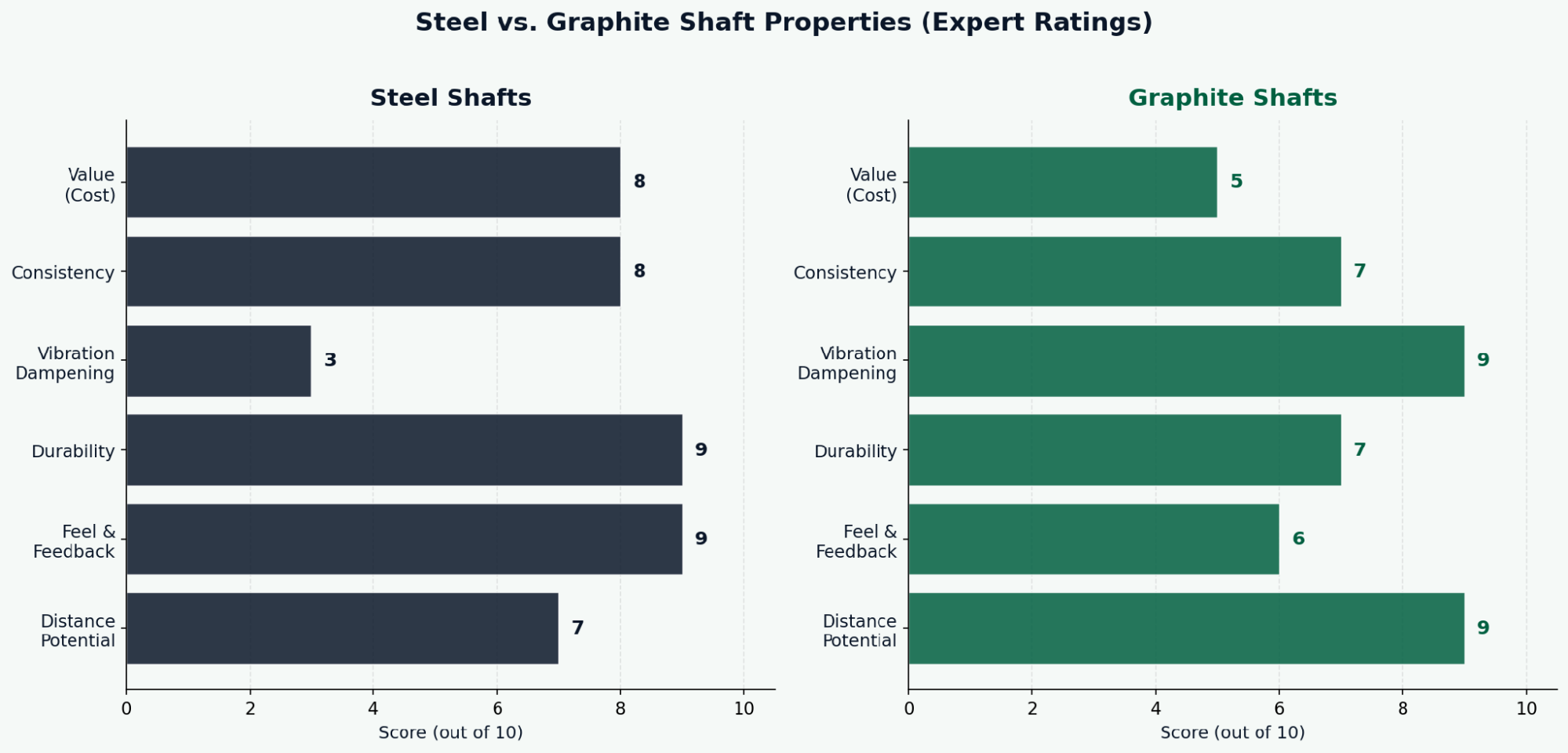
When a club strikes a ball, vibration travels up the shaft to the golfer’s hands almost instantaneously. The shaft material determines how much of that vibration is transmitted vs. absorbed.
Steel: The Feedback Champion
Steel shafts transmit vibration with minimal dampening. For skilled players, this is a feature: a center strike feels different from a heel or toe miss, and that tactile information helps players calibrate and improve. Tour players often describe well-struck irons with steel as having a “crisp,” “pure,” or “ringing” feel.
Graphite: Less Vibration, More Comfort
Graphite’s carbon fiber construction naturally absorbs and dampens vibration before it reaches the hands. This makes graphite significantly more comfortable for players with arthritis, joint inflammation, or hand/wrist injuries. The trade-off is reduced feedback.
Who Benefits Most: Golfers with any of the following conditions should strongly consider graphite irons regardless of swing speed: tennis elbow, golfer’s elbow, carpal tunnel syndrome, arthritis in the hands or wrists, rotator cuff issues, and post-surgery recovery.
Flex, Frequency Matching, and Set Consistency
Shaft flex is a rating (Ladies, Senior, Regular, Stiff, X-Stiff) indicating how much a shaft bends during the swing. But flex labels are not standardized. The only precise measurement of shaft stiffness is frequency, measured in cycles per minute (CPM).
Frequency matching ensuring each shaft in a set vibrates at consistently spaced intervals is the gold standard for set consistency. At Mitchell Golf, we use the DigiFlex 2.0 Frequency Meter to measure, document, and match shaft frequencies in professional settings.
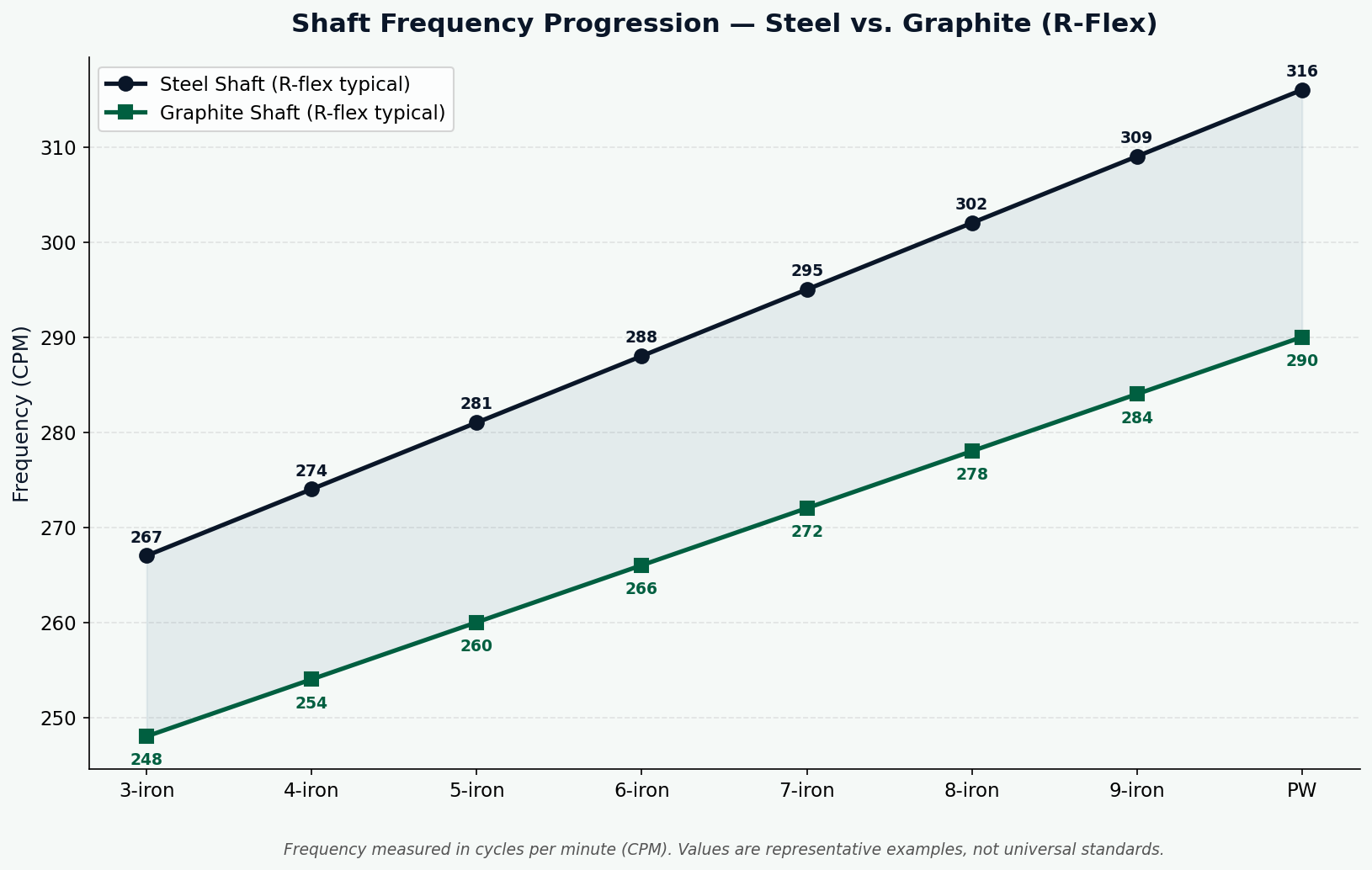
Why Steel and Graphite Flex Labels Are Incompatible
A steel “Regular” flex iron shaft typically measures around 295 CPM at 5-iron length, while graphite “Regular” measures 265–275 CPM. They are not equivalent in stiffness, even though both carry the same label.
This is why players who switch from steel to graphite often feel the clubs are “whippy” even in the same flex and why proper re-fitting after a material change is essential, not optional.
Technical Reference: For complete shaft frequency measurement guidelines, consult the Mitchell Golf Measuring & Bending Reference Guide the industry-standard reference used by PGA Tour equipment technicians.
Do Graphite Shafts Really Add Distance?
The short answer: sometimes yes, sometimes no and the mechanism matters more than the material.
Graphite shafts can add distance if and only if the lighter weight allows the golfer to generate meaningfully more clubhead speed without sacrificing contact quality. A player who gains 3 mph of ball speed from switching to graphite will see roughly 4-5 yards improvement with a 7-iron.
However, if the lighter shaft disrupts the golfer’s tempo causing them to rush the transition, over-swing, or lose timing contact quality drops and dispersion increases. Consistency of contact is the most powerful distance variable for the vast majority of recreational golfers.
Durability and Cost Comparison
Steel shafts have a significant durability advantage. A quality steel iron shaft will last decades under normal use and is extremely resistant to denting, cracking, or delamination. Graphite shafts, while greatly improved, can still be damaged by cart impacts, improper cleaning, or grip installation errors.
| Factor | Steel Shafts | Graphite Shafts |
| Cost per shaft (mid-range) | $8–$35 | $40–$120 |
| Full iron set cost (shafts only) | $60–$250 | $300–$900+ |
| Labor to reshaft (per club) | $15–$25 | $18–$30 |
| Expected lifespan | 15–30 years | 8–15 years |
| Damage resistance | Very high | Moderate |
| Rust/corrosion risk | Low (chrome finished) | None |
Caution: DIY Graphite Reshafting: Graphite shafts require different handling during installation than steel. Using excessive heat to remove a graphite shaft can cause micro-fractures in the carbon fiber that are invisible but compromise structural integrity. Always use a professional shaft puller and follow proper temperature guidelines.
Steel vs. Graphite by Club Type
The debate plays out differently depending on which clubs you’re talking about. Here’s how the recommendation breaks down by category:
| Club Type | Industry Standard | Recommendation |
| Driver | Graphite (always) | Graphite. No meaningful steel option at this length. |
| Fairway Woods | Graphite (always) | Graphite. Weight and length make it the only practical choice. |
| Hybrids | Graphite (standard) | Graphite. Steel utility irons are different from hybrids. |
| Long Irons (2–4 iron) | Mixed | Graphite often helps average players; steel preferred by low handicappers. |
| Mid Irons (5–7 iron) | Steel (traditional) | Depends on swing speed – the core of the debate. |
| Short Irons / Wedges | Steel (almost always) | Steel for precision and feel in the scoring zone. |
| Putter | Steel (standard) | Steel or custom. Graphite putters are a niche product. |
Can You Mix Steel and Graphite in One Bag?
Yes and it’s more common than many golfers realize. A typical mixed bag configuration: graphite in driver, fairway woods, and hybrids; steel or graphite in irons depending on fitting; steel in wedges.
The critical issue with a mixed set is maintaining consistent swing weight across the transition from graphite to steel. Use a swing weight scale to measure every club and ensure a smooth value (typically D0-D2 for men, C6-D0 for women) across all clubs.
Mitchell Golf’s fitting equipment, including swing weight scales, makes this process straightforward for any pro shop or club fitter.
How to Reshaft Your Clubs – Options and Costs
If you’ve decided to switch shaft materials, here’s the reshafting process step by step:
- Get a proper fitting first – measure swing speed, tempo, and transition force before spending money on new shafts.
- Select your shaft – work with your fitter to identify shaft options matching your data (e.g., True Temper Dynamic Gold for steel; Project X HZRDUS or Mitsubishi Tensei for graphite irons).
- Remove old shafts carefully – use professional shaft pullers (graphite requires lower heat than steel).
- Install and epoxy – clean the hosel, apply high-strength shaft epoxy, install at correct depth and spine alignment. Allow 24-hour cure.
- Verify loft, lie, and swing weight – reshafting can subtly alter hosel alignment. Re-check with a loft & lie machine.
- Regrip and finish – install new grips matched to your hand size.
Mitchell Golf Reshafting and Fitting Equipment
Re-Shafting Equipment
Professional shaft pullers for both graphite and steel, epoxy systems, ferrule tools, and shaft weights everything needed for production-quality reshafting work. View Re-Shafting Tools
Loft & Lie Angle Machines
After reshafting, always re-verify loft and lie angles. The SteelClub Signature and TourGauge Digital are the industry standard for angle measurement and adjustment.
Fitting Equipment
Swing weight scales, lie boards, frequency meters, and fitting aids. Browse Mitchell Golf Fitting Equipment for the complete toolkit.
Training Classes
Learn professional club fitting and reshafting from certified Mitchell Golf instructors. View Training Classes including the 2-Day Intro and 5-Day Master Performance School.