
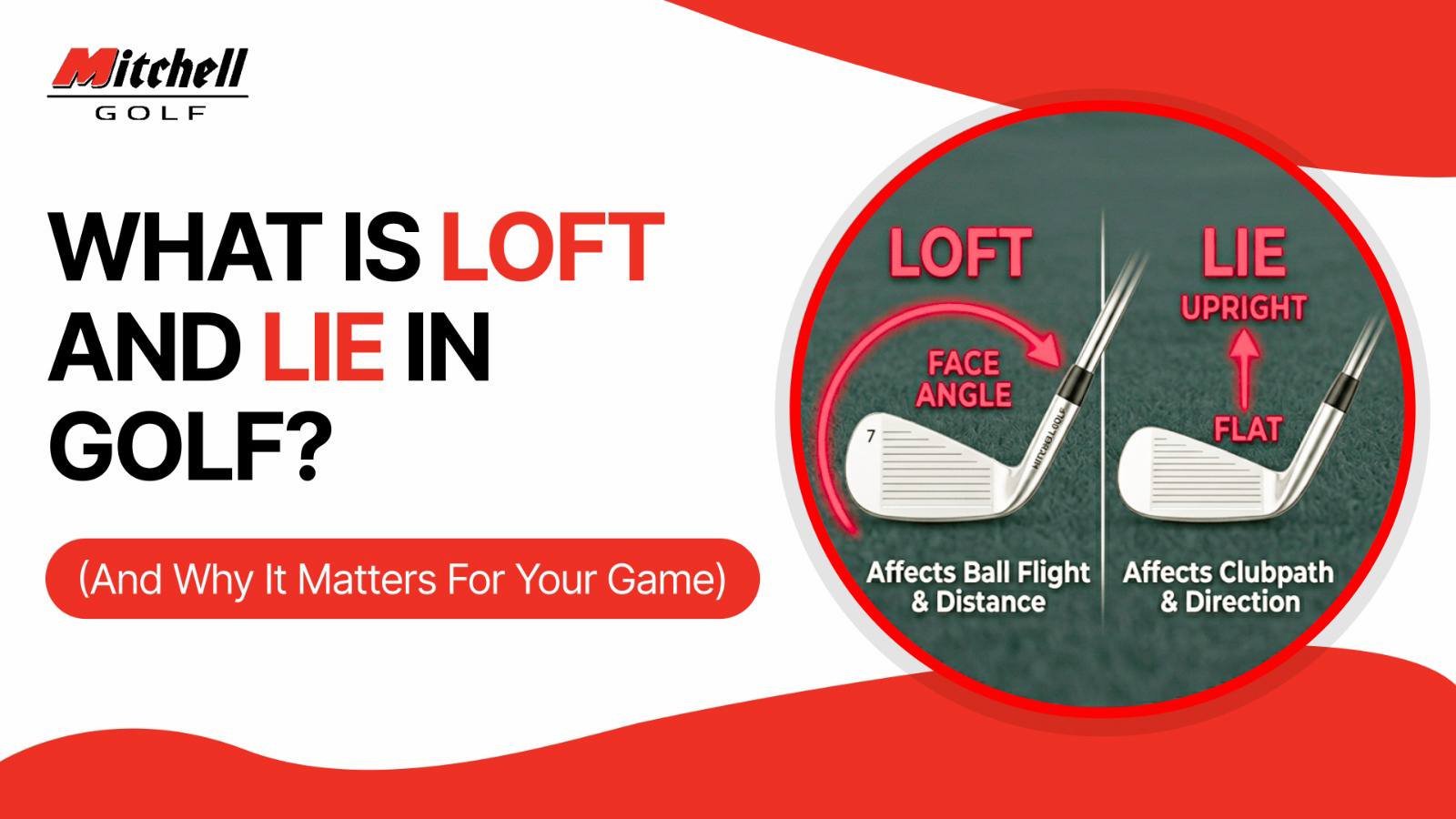
Most golfers spend thousands of dollars on new equipment but never check the two angles that determine where every shot actually goes. Loft controls how high and how far the ball flies. Lie angle influences whether it goes straight, left, or right. Get either one wrong and no amount of practice will fix the resulting inconsistency because the misdirection is built into the clubs themselves.
At Mitchell Golf Equipment Company, we have manufactured professional loft and lie angle machines since 1988. Our equipment is used by every major club manufacturer on their production lines, in their tour vans, and in PGA Tour fitting bays worldwide. This guide shares the same technical knowledge our machines are built on – explained clearly for every level of golfer.
Whether you want to understand what these terms mean, check whether your clubs are fitted correctly, or learn how professionals measure and adjust them, this is the complete resource.
What Is Loft Angle in Golf?
Loft is the angle formed between the clubface and a vertical reference line when the club is held in its natural playing position at address. In simple terms: it is how much the face tilts backward from vertical.
A driver face tilted just slightly back from vertical = low loft = low trajectory = maximum distance. A lob wedge with a dramatically tilted face = high loft = ball launches nearly straight up = very little distance. Every club in your bag sits somewhere on that spectrum.

Loft angle: the angle between the clubface and a vertical reference line. Higher loft = higher ball flight, less distance. Lower loft = flatter trajectory, more distance.
How loft is measured
Loft is measured in degrees. The proper method — as documented in Mitchell Golf’s official measuring and bending guide – registers the club by its face attitude, with the score lines parallel to a horizontal reference. This is critical: measuring loft from the sole (which some older methods do) is imprecise and unrepeatable. The face is what strikes the ball, so the face is what you measure from.
The “Standard” Myth: There is no universal industry standard for loft or lie. Mitchell Golf’s technical reference documents that four major manufacturers’ 5-irons use lie angles ranging from 60° to 62° — a 2-degree spread – and that their loft specs for the same club vary by as much as 2 full degrees. When someone says your clubs are “standard,” ask what specific degree number that means.
What Is a Lie Angle in Golf?
Lie angle is the angle formed between the shaft and the ground (the sole plane) when the club is in its correct playing position. It determines the angle at which the clubhead sits relative to the turf at address — and, crucially, at impact.
If the lie angle matches your swing and posture, the sole of the club will sit flat on the ground at impact. The face points directly at your target, and the ball starts on line. If the lie angle is wrong — even by a degree or two — the heel or toe will contact the ground first, twisting the face open or closed at the moment of impact.

Lie angle: the angle between the shaft and the ground at address. A correct lie angle means the sole sits flat at impact — producing a straight shot.
Why lie angle matters more on short irons
Here is something most guides miss: the higher the loft, the more a lie angle error affects ball direction. According to Mitchell Golf’s directional displacement research, a lie error of 2° on a wedge causes significantly more offline ball flight than the same 2° error on a low-lofted driver. This is because the higher loft amplifies any face twist into greater sidespin.
The practical implication: if your short irons and wedges are consistently off-line despite a solid swing, incorrect lie angle is almost always the first place to look.
Golf Club Loft Chart – Every Club Type
Loft increases progressively from the driver through the wedges. The chart below shows modern average lofts. Note that “game improvement” irons are often 2–4 degrees stronger (lower loft) than traditional models — meaning your 7-iron might hit as far as a 6-iron used to.

Modern average golf club lofts by club type. Source: Mitchell Golf Loft/Lie Reference Guide. Actual lofts vary by manufacturer.
| Club | Old Average Loft | Modern Average | Game-Improvement |
|---|---|---|---|
| Driver | 10° | 10.5° | 9–12° |
| 3-Wood | 15° | 15° | 13–16° |
| 5-Wood | 18° | 18° | 17–20° |
| 4-Hybrid | — | 22° | 21–24° |
| 3-Iron | 23° | 21° | 17–20° |
| 4-Iron | 26° | 24° | 20–23° |
| 5-Iron | 30° | 27° | 23–26° |
| 6-Iron | 34° | 31° | 27–30° |
| 7-Iron | 38° | 35° | 31–34° |
| 8-Iron | 42° | 39° | 35–38° |
| 9-Iron | 46° | 43° | 39–42° |
| PW | 50° | 47° | 43–47° |
| Gap Wedge | — | 51° | 50–52° |
| Sand Wedge | 56° | 56° | 54–58° |
| Lob Wedge | — | 60° | 58–64° |
| Putter | 4° | 3–4° | 2.5–4.5° |
Source: Mitchell Golf Loft, Lie & Face Angles Technical Reference. This table is a guide only — specifications vary by manufacturer and model.
Standard Lie Angles by Iron
Lie angles increase progressively from long irons to short irons. The table below shows both the older traditional averages and the modern averages, as documented in Mitchell Golf’s reference data. Notice that modern clubs tend to play slightly more upright — reflecting changes in average golfer posture and swing plane.
| Iron | Traditional Lie | Modern Lie | Notes |
|---|---|---|---|
| 1-Iron | 56° | 58.5° | Rarely used in modern sets |
| 2-Iron | 57° | 59° | — |
| 3-Iron | 58° | 60° | Starting lie for most sets |
| 4-Iron | 59° | 60.5° | — |
| 5-Iron | 60° | 61° | Most commonly tested in fitting |
| 6-Iron | 61° | 61.5° | — |
| 7-Iron | 62° | 62° | Most common lie board test iron |
| 8-Iron | 63° | 62.5° | — |
| 9-Iron | 64° | 63° | — |
| PW | 64° | 63.5° | — |
| SW | 64° | 64° | Highest lie angle in standard set |
Source: Mitchell Golf Equipment Co. Loft/Lie/Face Angles Reference. Numbers are averages — individual fitting always supersedes these specs.
Why “Standard” Is Misleading: When a club fitter recommends “2 degrees upright,” that instruction only makes sense if you know the starting point. Mitchell Golf’s data shows the same iron from different manufacturers can start at different lie angles — so “2 degrees upright from standard” means different things depending on which brand you own. Always specify actual degree numbers (e.g., 63°) rather than relative terms.
How Loft Affects Your Game
Trajectory and distance
The relationship between loft and distance is the most visible effect in golf. More loft = more backspin = higher, shorter ball flight. Less loft = less backspin = flatter, longer ball flight. This is why drivers have 9–12° of loft while lob wedges have 58–64°.
However, loft does not work in isolation from swing speed. A slow swing generates less ball speed, meaning it needs more loft to achieve optimal launch angle and carry distance. A faster swing can use lower loft efficiently. This is why professional club fitting checks actual launch conditions, not just the number stamped on the club.
The gapping problem
One of the most important — and most overlooked — applications of loft checking is distance gapping. Your clubs should create roughly equal distance gaps between each club, typically 10–15 yards per club for most players. When lofts are not progressively consistent within a set, two adjacent clubs can hit nearly identical distances, leaving a gap elsewhere in your set.
Mitchell Golf’s technical data confirms that manufacturers cannot guarantee precise, consistent lofts across an entire set due to production tolerances. The practical result: most sets come off the shelf with loft inconsistencies that can be corrected through professional adjustment.
Pro Shop Standard: In a professional fitting workflow, loft verification and gapping always comes first. Correcting uneven loft gaps between clubs resolves distance issues. Correcting lie corrects direction. Always sequence the work this way — loft for distance, lie for direction.
Bounce angle – the hidden relationship
Few golfers know that loft and bounce angle are directly linked. When a club’s loft is changed by bending, the bounce angle changes by exactly the same amount. Decrease loft by 2° and you decrease bounce by 2°. This matters most for wedges, where bounce is a key performance factor for turf and sand interaction. Professional fitters account for bounce when making loft changes.
How Lie Angle Affects Your Game

Lie angle and ball direction: too flat causes the toe to dig in at impact, opening the face and pushing the ball right. Too upright causes the heel to dig in, closing the face and pulling the ball left. (Right-handed golfer shown.)
Too flat – ball curves right
When a club’s lie angle is too flat, the toe of the club contacts the ground first at impact. This prevents the toe from rotating over naturally and forces the heel forward, which opens the face. An open face at impact sends the ball to the right for a right-handed golfer — fades and slices become the pattern, even with an otherwise good swing.
Too upright – ball curves left
When a club’s lie angle is too upright, the heel digs into the ground first. This flips the toe over rapidly, closing the face at impact. A closed face sends the ball left for a right-handed golfer — pulls, hooks, and a persistent left miss become the norm.
The directional displacement effect
According to Mitchell Golf’s research, a lie angle error of just 2° can cause the ball to start 2–5 yards off-line on a standard approach shot. On a wedge shot to a flag 30 yards away, that level of misdirection is the difference between a makeable putt and a chip. Lie angle matters most on the clubs you use most often in scoring situations — short irons and wedges.
| Situation | What Happens at Impact | Ball Flight (Right-Handed) |
|---|---|---|
| Lie is too flat | Toe contacts ground first; face opens | Ball curves right (fade / slice) |
| Lie is correct | Sole sits flat; face square to target | Ball goes straight |
| Lie is too upright | Heel contacts ground first; face closes | Ball curves left (draw / hook) |
Static vs. Dynamic Loft — The Key Distinction
Static loft is the loft stamped on the club or measured when the club is at rest. It is the number used in spec sheets and the data table above.
Dynamic loft is the actual effective loft of the clubface at the exact moment of impact, during a real swing. Dynamic loft changes based on:
- Forward shaft lean: Pressing your hands forward at impact reduces effective loft (de-lofting the club). Tour professionals often deliver 3–6° less loft than the static spec.
- Shaft flex and bend point: Under load during the downswing, the shaft bends and can add or subtract loft at impact depending on timing.
- Angle of attack: Hitting down on the ball reduces dynamic loft; hitting up increases it (relevant for driver optimization).
This is why two players using the same 7-iron can hit it very different distances and trajectories — their dynamic lofts at impact are different. A launch monitor reading is the only way to measure actual dynamic loft accurately.
Why This Matters for Fitting: If you always hold significant forward shaft lean, your static lofts may need to be set stronger (lower) to compensate and maintain proper gapping. A professional club fitter using a launch monitor can quantify your dynamic loft and recommend appropriate static loft adjustments.
Playing loft in metal woods and hybrids
Woods and hybrids add another layer: face angle directly affects playing loft. When the club’s face is built in a closed position (pointing slightly left of center), it increases the playing loft. An open face angle reduces it. The relationship is approximately 1:1 — a 1° closed face angle adds approximately 1° of playing loft.
This is why some manufacturers build a closed face into drivers for added draw bias — it also quietly increases playing loft. When adjusting woods for face angle using a Mitchell angle machine, the fitter must account for the corresponding loft change.
The Lie Board Test: How to Check Your Lie Angle
The lie board test is the industry-standard method for determining whether a club’s lie angle matches your swing. It requires only a flat hitting board, sole tape (or masking tape), and a medium iron — most commonly a 5-iron or 7-iron.

Reading the lie board test: where the mark appears on the sole tape tells you exactly how to adjust. Centered = correct. Toe = too flat (bend more upright). Heel = too upright (bend more flat).
How to perform the test
- Apply sole tape. Place a strip of masking tape or purpose-made sole impact tape on the sole of a mid-iron (5-, 6-, or 7-iron works best). Mark the center of the sole across the tape as a reference.
- Set up with a lie board. Place a flat, rigid board (hard rubber or specialized lie board) on the ground where you would normally address the ball. The board must be level.
- Hit normal shots. Take 4–5 real swings, striking actual balls off the board. Swing normally — do not try to flatten or steepen to compensate. You want to capture your natural delivery.
- Read the mark. After each swing, inspect the tape mark left by the board on the sole. Mark centered = lie angle is correct. Mark toward the toe = club is too flat, needs to be bent more upright. Mark toward the heel = club is too upright, needs to be bent more flat.
- Quantify the adjustment needed. As a general guide from Mitchell Golf’s fitting methodology: for every 1/4 inch the mark deviates from center toward the toe, approximately 1° of upright correction is needed. Measure the entire set individually — never assume all clubs need the same adjustment.
Pro Tip: Because manufacturers cannot guarantee progressively consistent lie angles across an entire set, each club must be tested and adjusted independently. Do not test one club and bend the whole set by the same amount. See Mitchell Golf’s Guide to Measuring and Adjusting Golf Club Angles for the complete professional workflow.
Who Needs a Loft and Lie Adjustment?
Not every golfer needs adjustment — but more do than realize it. Here are the most common situations where loft and lie checking is strongly recommended:
| Situation | Why Loft / Lie Should Be Checked |
|---|---|
| Persistent shot shape bias | A consistent fade or draw that remains even after swing corrections is often a lie angle issue — the bias is built into the club. |
| Uneven distance gaps between clubs | Two clubs hitting similar distances usually means loft is inconsistent. A 6-iron hitting the same as a 7-iron is a loft gapping problem. |
| New set purchase | Factory production tolerances (typically ±1°) mean any new set can have loft and lie errors. Checking at purchase eliminates this risk. |
| Change in posture or setup | If you have changed your stance width, ball position, or posture significantly — perhaps after lessons or injury — your existing lie angles may no longer match your delivery. |
| Taller or shorter than average players | Standard lie angles are designed for golfers of average height and arm length. Players significantly taller or shorter will almost always need upright or flat adjustments. |
| Clubs used more than 2–3 years | Repeated impacts on hard surfaces can alter loft and lie over time, particularly in higher-lofted clubs. Annual verification is standard practice in professional shops. |
What Golf Clubs Can Be Bent?
Not all clubs can be adjusted equally. The material a club is made from determines how much — and whether — it can safely be bent for loft and lie correction.
| Material | Bending Limit | Notes |
|---|---|---|
| Forged carbon steel | Up to 4–5° | The most bendable material. Preferred for custom fitting. Most player’s irons are forged. |
| 431 Stainless steel (cast) | 2–4° | Softer stainless — game-improvement irons often use this. Bends reasonably well with proper equipment. |
| 17-4 Stainless steel (cast) | Up to 2° | Harder and more brittle. Can be bent, but requires a powerful machine and careful technique. |
| Zinc alloy (die cast) | Not recommended | Brittle material that breaks easily. Test with a magnet — zinc is non-magnetic. Do not attempt to bend zinc clubs. |
| Stainless / forged titanium woods | Lie and face angle only | Loft cannot be directly bent on woods. Face angle adjustments change playing loft as a secondary effect. |
| Cast titanium drivers | Not bendable | Adjustable hosels (manufacturer-built settings) are the only option for most modern drivers. |
Warning — Clubs Have No “Memory”: A common misconception is that clubs will spring back to their original spec after bending. According to Mitchell Golf’s technical documentation, this is not true. Once a club is bent, it stays at the new specification until physically bent again. A properly bent club will maintain its corrected angles indefinitely.
The Professional Adjustment Process
Adjusting loft and lie is not a task for guesswork or hand tools. The professional standard requires a dedicated angle machine that registers the club by its face attitude — not the sole — to measure and bend with precision and repeatability.
“It is commonly agreed the accuracy and bending capability of Mitchell® Angle Machines set the industry standard for aftermarket club adjustment and fitting.” — Mitchell Golf Equipment Company Technical Reference Guide, Ed Mitchell PGA. Read why Mitchell is #1 on Tour →
Mitchell Golf Angle Machines
SteelClub Signature Angle Machine — Irons, Hybrids & Woods
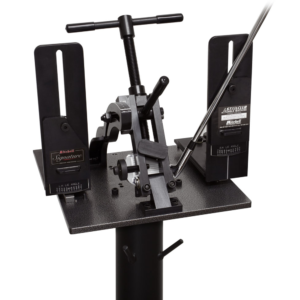 Dual precision gauges measure and bend loft, lie, and face angles simultaneously. The most versatile machine in the Mitchell lineup — used in professional shops and manufacturer fitting centers worldwide.
View SteelClub Signature Machine →
TourGauge Digital Irons Machine

Precision slide-bearing gauge assembly with LED digital display. Records loft and lie measurements in 1/4° increments for maximum accuracy. Preferred by fitting professionals who demand laboratory-grade repeatability.
View TourGauge Digital Machine →
TourGauge Putter Bending Machine
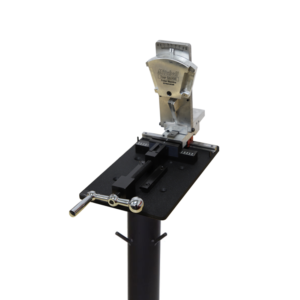
CNC-machined precision for putter loft and lie adjustments. Putters are often overlooked in fitting — yet an incorrect putter lie angle affects alignment at address and can directly cause missed putts.
View TourGauge Putter Machine →
The professional workflow
- Measure current angles. Each club is registered in the angle machine by its face attitude (score lines parallel to horizontal). Current loft and lie are recorded in actual degrees.
- Perform the lie board test. The golfer hits shots off a flat lie board with sole tape applied. The resulting marks indicate what adjustments are needed for each club individually.
- Check loft gapping. Lofts of the full set are compared. Any clubs with overlapping or uneven lofts are identified and targeted for correction.
- Bend and re-measure. Each club is adjusted using appropriate bending bars, then immediately re-measured to verify the new angles are precisely correct. The process: measure, bend, re-measure, with zero tolerance.
- Document final specifications. Every club’s final loft and lie angles are recorded for the golfer. This becomes their personal “standard” — used for future verification or when switching to a new set.
Frequently Asked Questions
What is the difference between loft and lie in golf?
Loft is the angle between the clubface and a vertical reference line — it controls trajectory and distance. Lie is the angle between the shaft and the ground at address — it controls left-right direction. Both are measured in degrees and both can be professionally adjusted to fit your swing.
What is loft angle in golf clubs?
Loft angle is the angle formed between the clubface and a vertical reference line when the club is in the address position. Higher loft (like a lob wedge at 60°) produces higher, shorter shots. Lower loft (like a driver at 10.5°) produces lower, longer shots. Loft is the primary factor controlling trajectory and distance.
What is lie angle in golf clubs?
Lie angle is the angle between the shaft and the ground (sole plane) when the club is in its correct playing position. If the lie angle is too upright, the heel digs into the ground at impact and the ball curves left (for right-handed golfers). If too flat, the toe digs in and the ball curves right.
How do I know if my lie angle is correct?
The lie board test is the professional standard. Apply sole tape to the bottom of an iron, swing it off a flat board, and read where the mark appears. A centered mark means the lie is correct. A mark toward the toe means the club is too flat (needs bending more upright). A mark toward the heel means too upright (needs bending more flat). A professional fitter with a Mitchell angle machine can measure and adjust your clubs in a single session.
Does loft and lie affect ball flight?
Yes, significantly. Loft determines how high and how far the ball goes. Lie angle determines left-right direction — incorrect lie forces the clubface to either open or close at impact, sending the ball offline even with a perfect swing. Lie angle has more directional influence on high-lofted clubs like wedges than on lower-lofted clubs like drivers.
Can loft and lie be adjusted on any golf club?
Most steel irons can be bent 2–4 degrees. Forged carbon steel bends most easily; 17-4 stainless steel can be bent with proper equipment. Graphite-shafted clubs bend at the hosel, not the shaft itself. Zinc clubs should not be bent. Cast titanium drivers are not adjustable by bending.
What is the difference between static and dynamic loft?
Static loft is the loft stamped on the club or measured at rest. Dynamic loft is the actual loft of the clubface at the moment of impact, which changes based on shaft flex, shaft lean (forward/backward), and swing characteristics. Most golfers deliver less loft at impact than the static spec suggests due to forward shaft lean.
Is there a standard loft and lie for all golf clubs?
No. There is no universal industry standard. Mitchell Golf’s official documentation explicitly states: “There are no industry standards for lie angles. The player’s performance is the best indicator of correct lie angles.” Always work in actual degree numbers, not relative terms like “standard” or “2 degrees flat.”
Sources: Mitchell Golf Loft/Lie/Face Angles Technical Reference; Ed Mitchell PGA Measuring and Bending Guide (2017); Mitchell Golf Angle Machines product documentation (2026).